
How Many SAT Practice Tests Should You Take? The Honest, Data-Backed Answer for 2026

On this page
- The Short Answer: How Many SAT Practice Tests You Actually Need
- How Many SAT Practice Tests by Score Band and Timeline
- Why Review Time Matters More Than Test Count
- How to Space Your SAT Practice Tests for Maximum Gain
- Which Bluebook Practice Tests Are Most Accurate for the 2026 SAT
- How Much SAT Practice Should You Do Each Day Between Tests
- When You Have Taken Enough SAT Practice Tests
- FAQ
- Is a 1500 SAT score in the top 1 percent?
- Is SAT Practice Test 4 or Practice Test 5 harder?
- How many full-length SAT practice tests are available on Bluebook?
- Should I take a practice test the day before the SAT?
- What is the 3-to-1 rule on the SAT?
- Is taking a practice test every day too much?
- Ready to Turn Practice Tests Into a Real Score
Most students should take roughly 4 to 6 full-length SAT practice tests before their official exam. If you have about 3 to 4 weeks of prep, aim for 2 to 3 tests. If you have 8 to 12 weeks, plan on 4 to 6. Chasing a gain of 150 points or more over 16 to 24 weeks? Work through 6 to 8. Space each test roughly 2 to 3 weeks apart, and spend at least three hours reviewing every test before you move to the next. All official practice tests are free in the Bluebook app from College Board.
Those numbers come from College Board's own practice guidance combined with what we see across student cohorts at IvyStrides. Test count is the easy question, though. The harder question, and the one that actually decides your score, is what happens in the two weeks between each test. The rest of this article covers the score-band math, the 3-to-1 review rule, and how to know when you've done enough.
The Short Answer: How Many SAT Practice Tests You Actually Need
Here's the tier breakdown, straight.
Short prep window (about 3 to 4 weeks): 2 to 3 full-length tests. College Board recommends at least 2 full-length tests before test day. On a compressed timeline, one diagnostic baseline at the start and one confirmation test 5 to 7 days before the exam is the floor. A third test in the middle is ideal.
Standard prep window (about 8 to 12 weeks): 4 to 6 full-length tests. This is where most juniors land. One test every 2 to 3 weeks, with structured targeted weakness work between each.
Extended prep window (roughly 16 to 24 weeks): 6 to 8 full-length tests. This tier is for students targeting a gain of 150 points or more, or students starting below 1200 and aiming for 1350+. More tests only help here if paired with error log review after each one.
Every one of these tests should come from Bluebook. As of 2026, at least 12 full-length official Digital SAT practice tests are available in the app, and College Board adds new forms periodically. Verify the current count on the official SAT suite site before you build your schedule, since the library refreshes. For a curated set of practice materials organized by score band, see our official SAT practice tests library.
How Many SAT Practice Tests by Score Band and Timeline
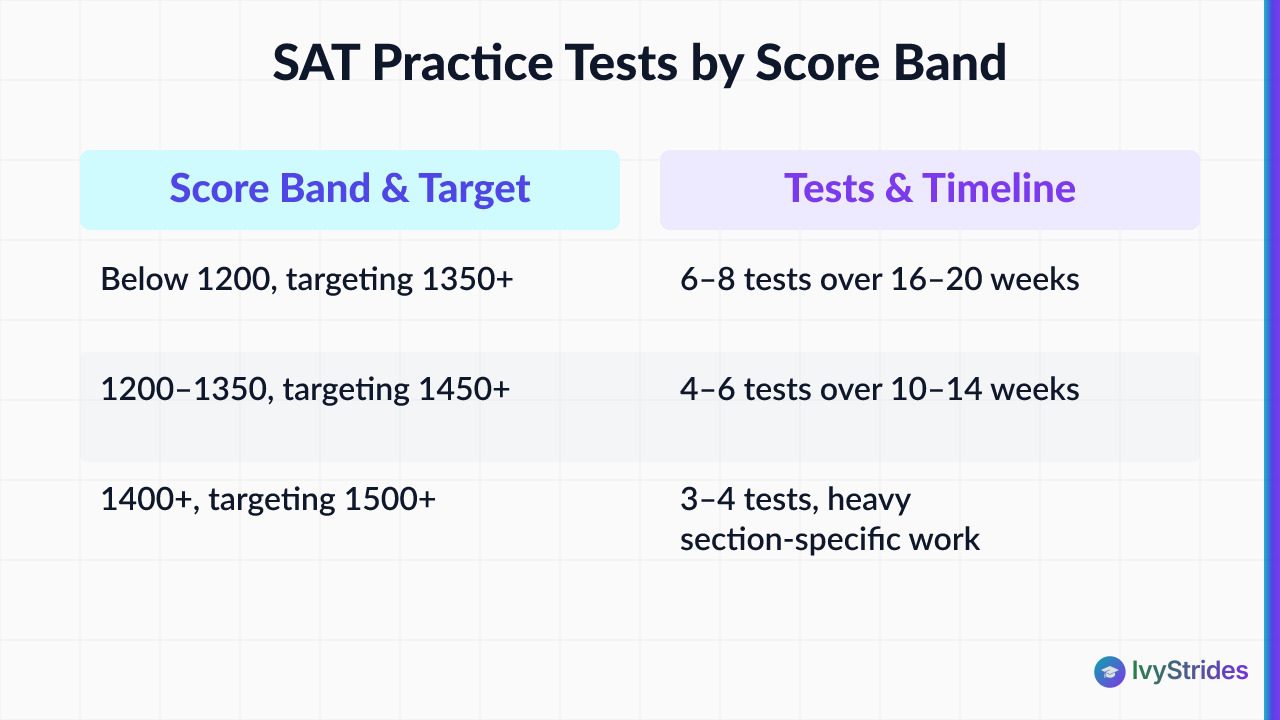
Timeline is one input. Your starting score is the other. Understanding what your practice score actually means in percentile terms helps you set a realistic target, so anchor to our breakdown of SAT percentiles before you commit to a number.
Rough benchmarks from College Board percentile data: a score around 1170 sits near the 70th percentile of test-takers, and 1500 sits at approximately the 99th percentile on the 400 to 1600 scale. Now the score-band recommendations.
Starting below 1200, targeting 1350+. In our coaching with students in this band, roughly 6 to 8 full-length tests over about 16 to 20 weeks is typical, because the score gap is 150+ points and roughly half of that gain comes from concept work in Algebra, Advanced Math, and Command of Evidence. More than 8 tests without dedicated concept review rarely moves the score.
Starting 1200 to 1350, targeting 1450+. Typically 4 to 6 tests over about 10 to 14 weeks. At this band, students have most of the concepts but are losing points on adaptive Module 2 hard-routing and Rhetorical Synthesis pacing. Fewer tests, deeper review.
Starting 1400+, fine-tuning toward 1500+. Roughly 3 to 4 tests, with heavy section-specific work between each. In our coaching with students in the 1400 to 1450 range, 3 to 4 targeted practice tests combined with drilling the specific Module 2 hard-path question types is more effective than 6 to 8 untargeted tests. At this level you're not building capacity, you're plugging specific leaks.
Your practice count should also inform how many official SAT attempts you plan, since each official test date is a data point in your superscore strategy. Read our full guide on how many times can you take the SAT before locking in your test dates.
Why Review Time Matters More Than Test Count
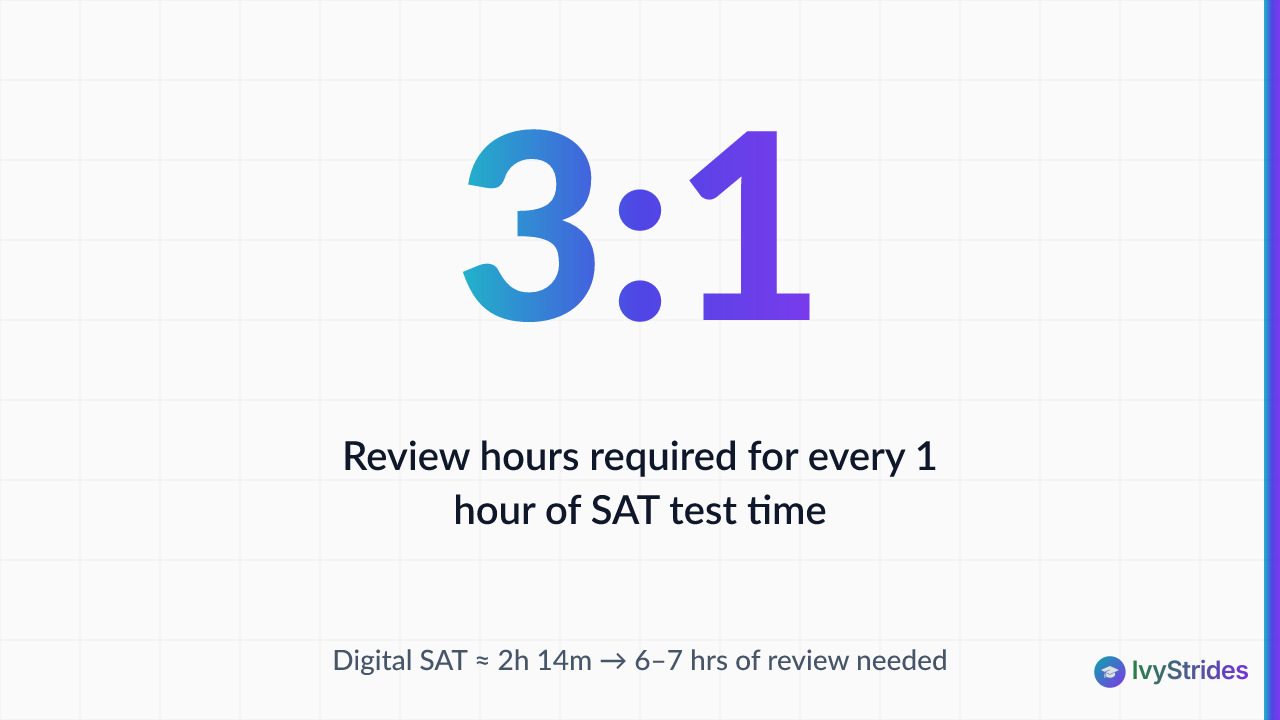
Here's the part most students miss. The practice test isn't where your score improves. The review is.
The 3-to-1 review rule: for every one hour of test time, spend three hours reviewing. The Digital SAT runs approximately 2 hours and 14 minutes, so a proper review session runs roughly 6 to 7 hours, spread across 3 to 5 days after the test. That's not padding. That's where the score gain actually happens.
In our coaching, students who skip structured review between tests typically plateau within 2 to 3 tests regardless of how many they take. You'll see the same 1280 come back three times in a row, and it feels like the test is broken. It isn't. You're measuring the same performance without changing the inputs.
A structured error log breaks every missed question into one of four categories: careless error, concept gap, pacing error, or adaptive-module routing error. Careless errors mean you knew it and slipped. Concept gaps mean targeted drilling. Pacing errors mean timed section rehearsal. Adaptive-module routing errors matter because Digital SAT Module 2 hard-routing typically requires consistent Module 1 accuracy above roughly 75 percent to access the higher-scoring path. If you're missing that routing consistently, no amount of Module 2 practice fixes it. You need to fix Module 1 first.
Use our free sat mistake tracker as your error log template. If you want the full methodology behind score gains at this scale, read how to raise your SAT score 200 points. Taking the right number of practice tests is only half the equation; the diagnostic-driven review process between tests is what actually moves the score needle, which is why students in our coaching who follow the spaced-retesting protocol typically see larger gains than those who repeat full-length tests back to back.
How to Space Your SAT Practice Tests for Maximum Gain
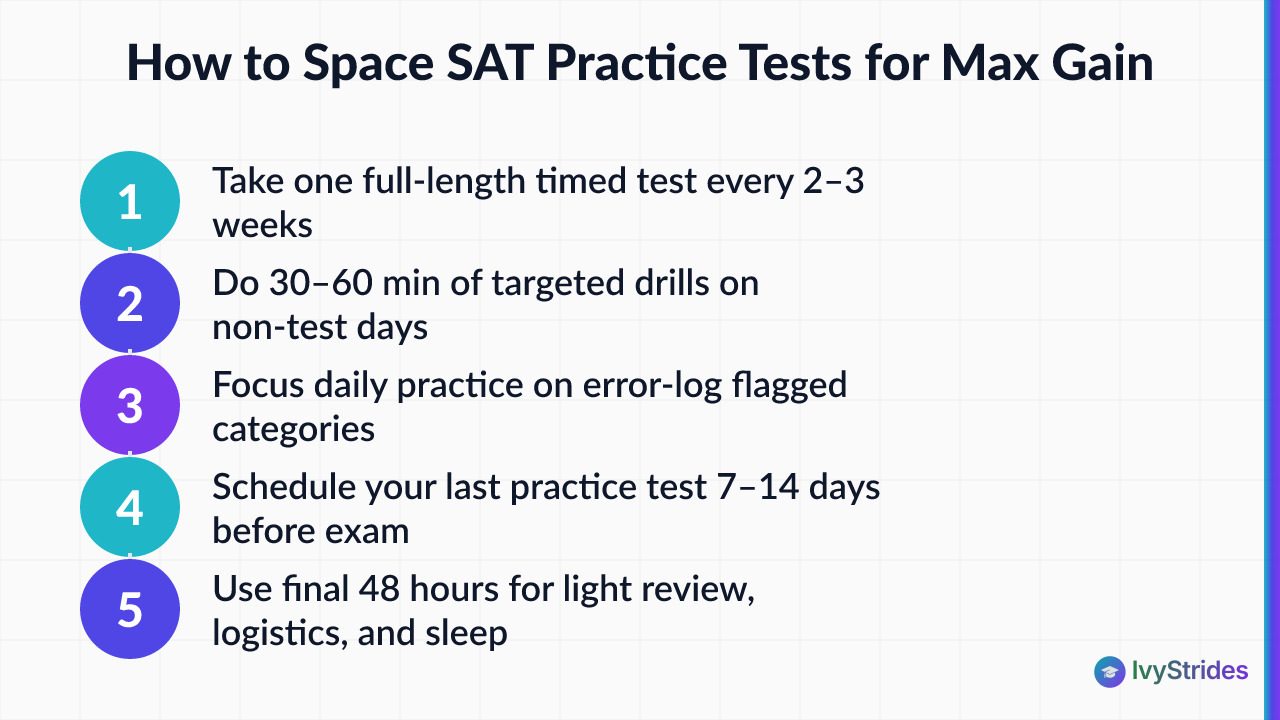
One full-length timed simulation every 2 to 3 weeks. That's the cadence.
Why the gap? Because a week isn't enough time to work through the error log, drill the identified weak areas, and let the corrections consolidate. Students in our coaching who space tests 2 to 3 weeks apart with structured review between each typically show more consistent score progression than those testing weekly.
On non-test days, roughly 30 to 60 minutes of targeted question-set work is more effective than another full-length test. That's about 5 to 7 hours per week for standard 8 to 12 week prep, or roughly 8 to 12 hours per week for extended prep targeting 150+ point gains. Focus daily drills on the exact categories your error log flagged, not on random practice.
Your final practice test should land 7 to 14 days before the official exam, not the day before. A full-length test the day before increases mental fatigue without giving you time to act on what you learned. The 48 hours before test day are for light error-log review, logistics, and sleep. Nothing else.
Test stamina is a trainable skill. If you've never sat through 2 hours and 14 minutes of focused work, you'll lose points in Module 2 of the Math section from decision fatigue alone. Full-length simulations are the only way to build that endurance. For students whose practice scores drop significantly under timed conditions, full-length simulations also serve as an anxiety-management tool, and pairing them with pacing strategies can close the gap between untimed and timed performance.
If you want a week-by-week schedule that maps practice tests onto targeted study sessions, our 30-Day SAT Study Plan 2026 shows exactly how to slot each full-length test into a structured prep calendar. For a broader framework, the official SAT study guide 2026 covers concept sequencing across R&W and Math.
Which Bluebook Practice Tests Are Most Accurate for the 2026 SAT
Bluebook is the only source of official Digital SAT practice tests that replicate the real adaptive experience. Third-party paper tests, no matter how well-written, don't route you into a harder or easier Module 2 based on your Module 1 performance, so they can't predict your official score with the same accuracy.
As of 2026, at least 12 full-length official Digital SAT practice tests are available in the Bluebook app, and College Board added a new form in early 2026. Check the current Bluebook practice test list before you plan, because the library updates.
Which tests should you prioritize? Tests 4 through 10 are currently the most representative of the 2026 Digital SAT experience. Earlier forms in the library reflect the initial 2024 rollout and are still useful, but Tests 4 through 10 map most closely to the question style and pacing you'll see on test day.
Is Practice Test 4 harder than Practice Test 5? Neither is definitively harder in a way that will move your official score prediction. Score variation of roughly 20 to 40 points between tests is normal and reflects natural difficulty variation across test forms. Don't chase the difference. Look at your average across your three most recent tests, and use that as your working score. A single practice score, high or low, is noise.
Because the Digital SAT routes you into a harder or easier Module 2 based on your Module 1 performance, each practice test in Bluebook gives you a realistic simulation of that adaptive experience, making official Bluebook tests far more predictive than third-party paper tests. For the full mechanics of how routing works, see our breakdown of SAT adaptive testing and our timing article on how long is the SAT.
How Much SAT Practice Should You Do Each Day Between Tests
Not another full-length test. That's the short version.
Taking a full-length practice test every day is counterproductive. It leaves no time for the review and targeted work that actually drive score improvement, and it burns out the exact focus reserves you're supposed to be building. Instead, on non-test days, run roughly 30 to 60 minutes of focused question sets targeting the specific weaknesses your error log flagged.
Weekly hour targets:
- Standard 8 to 12 week prep: about 5 to 7 hours per week total, including one full-length test every 2 to 3 weeks.
- Extended prep targeting 150+ point gains: roughly 8 to 12 hours per week total.
For the Reading and Writing section, daily drills should rotate across the four question domains: Command of Evidence (Textual and Quantitative), Rhetorical Synthesis, Transitions, and Boundaries. In our coaching, most students at the 1200 to 1400 band lose points primarily in Rhetorical Synthesis and Transitions. If that's you, weight your daily drills accordingly.
For the Math section, rotate across Algebra (linear equations, systems), Advanced Math (nonlinear functions, quadratics), Problem-Solving and Data Analysis, and Geometry and Trigonometry. For a full domain-by-domain breakdown, see our guide to SAT Math topics. If you're consistently under-scoring on Math relative to R&W, our online SAT Math tutor service pairs students with a section specialist.
When You Have Taken Enough SAT Practice Tests
Three signals tell you you're ready to sit the official exam.
One: three consecutive Bluebook practice tests fall within roughly 30 to 40 points of your target score, under full timed simulation conditions. Not one lucky test. Three in a row.
Two: your error log shows fewer than 5 repeat errors per section. If you're still missing the same Command of Evidence question type on test 5 that you missed on test 2, you haven't addressed the underlying gap, and another practice test won't fix it.
Three: your pacing is stable across both modules. You're finishing Module 1 with 2 to 4 minutes to review flagged questions, and Module 2 without rushing the final 3 questions. That's the pacing profile that translates to real test day.
Beyond 8 tests without structured review, additional tests rarely move the score. In our coaching, students who take more than 8 practice tests without the 3-to-1 review protocol between them typically stop seeing gains from the extra tests alone. At that point the ceiling is your review process, not your test count.
For the last 72 hours before your official SAT, follow our last minute SAT tips. For students who want a structured, section-specialist coached program instead of self-guided prep, our SAT prep overview walks through the full methodology. If you want a coach to determine readiness for you, that's 1-on-1 SAT prep.
One caveat worth naming. Practice test scores are predictive, but not identical to official scores. Score variation of roughly 20 to 40 points between practice and official is normal. Test-optional policies also vary by school and year, so if your target list includes test-optional colleges, verify current policies at each school's admissions page or the FairTest tracker before deciding whether to submit your score.
FAQ
Is a 1500 SAT score in the top 1 percent?
Yes. A score of 1500 places a student at approximately the 99th percentile of all SAT test-takers, based on College Board percentile data. Reaching this range typically requires a starting point at or above 1300 and roughly 10 to 16 weeks of structured prep with section-specific work. For deeper context on what specific scores mean at specific colleges, see our SAT percentiles guide.
Is SAT Practice Test 4 or Practice Test 5 harder?
Neither is definitively harder in a way that meaningfully affects your official score prediction. Score variation of roughly 20 to 40 points between Bluebook practice tests is normal and reflects natural difficulty fluctuation across test forms, not a scoring flaw. Focus on your average score across three or more recent tests. Tests 4 through 10 are currently the most representative of the 2026 Digital SAT.
How many full-length SAT practice tests are available on Bluebook?
As of 2026, at least 12 full-length official Digital SAT practice tests are available in the Bluebook app, which is free from College Board. A new test was added in early 2026, and College Board releases additional forms periodically. Verify the current count on the official SAT suite site before planning. Always use Bluebook as your primary practice source, because it's the only platform that replicates the real adaptive module routing.
Should I take a practice test the day before the SAT?
No. A full-length practice test the day before your official exam increases fatigue without giving you time to act on what you learn. Your final full-length test should land 7 to 14 days before test day. The day before is for light error-log review, logistics, and rest.
What is the 3-to-1 rule on the SAT?
The 3-to-1 rule is a review protocol: for every one hour of test time, spend three hours reviewing. The Digital SAT runs approximately 2 hours and 14 minutes, so a complete review session runs roughly 6 to 7 hours, spread across 3 to 5 days. This is where score improvement actually happens, through categorizing errors, revisiting concept gaps, and drilling the specific question types you missed.
Is taking a practice test every day too much?
Yes, for nearly every student. Daily full-length tests leave no room for the review and targeted drills that drive score gains, and they burn out the focus you're supposed to be building. Effective daily practice is roughly 30 to 60 minutes of focused question sets targeting your identified weak areas, with a full-length test reserved for every 2 to 3 weeks as a progress checkpoint.
Ready to Turn Practice Tests Into a Real Score
The number that matters isn't 4 or 6 or 8. It's whether each test you take is paired with the review that turns errors into points. Get the spacing right, run the 3-to-1 review after each one, and the test count takes care of itself.

Two decades teaching quantitative and verbal aptitude on standardized tests. Rare dual expertise across Math and Verbal — particularly effective for students with gaps on both sides. Senior AP Mentor for our Calculus and English tracks.