
How Many Colleges Should You Apply To? Sizing a List From Abroad

On this page
- How Many Colleges Should You Apply To? The 10 to 14 Baseline Explained
- How to Classify Each College on Your List as Reach, Target, or Safety
- Why Applying to Too Many Colleges Usually Backfires
- How International Applicants Should Adjust Their College List Size
- FAQ: How Many Colleges to Apply To
- What is a good number of colleges to apply for?
- How many colleges can you apply to in the US?
- Is applying to 15 colleges too many?
- What is the ideal number of colleges to apply to?
- Your Next Step on Sizing a College List
For most students, IvyStrides recommends 10 to 14 colleges: 2 to 3 reaches, 5 to 7 targets, and 2 to 3 safeties. A college list is the set of schools you formally apply to. Common App caps that list at 20 colleges, so your real limit is how many applications you can finish well.
Those Common App numbers come from its student solutions center, which allows up to 20 colleges per applicant. The harder question isn't the ceiling. It's how to split a sane number of schools across tiers that actually match your profile, and international applicants usually add a few more.
How Many Colleges Should You Apply To? The 10 to 14 Baseline Explained
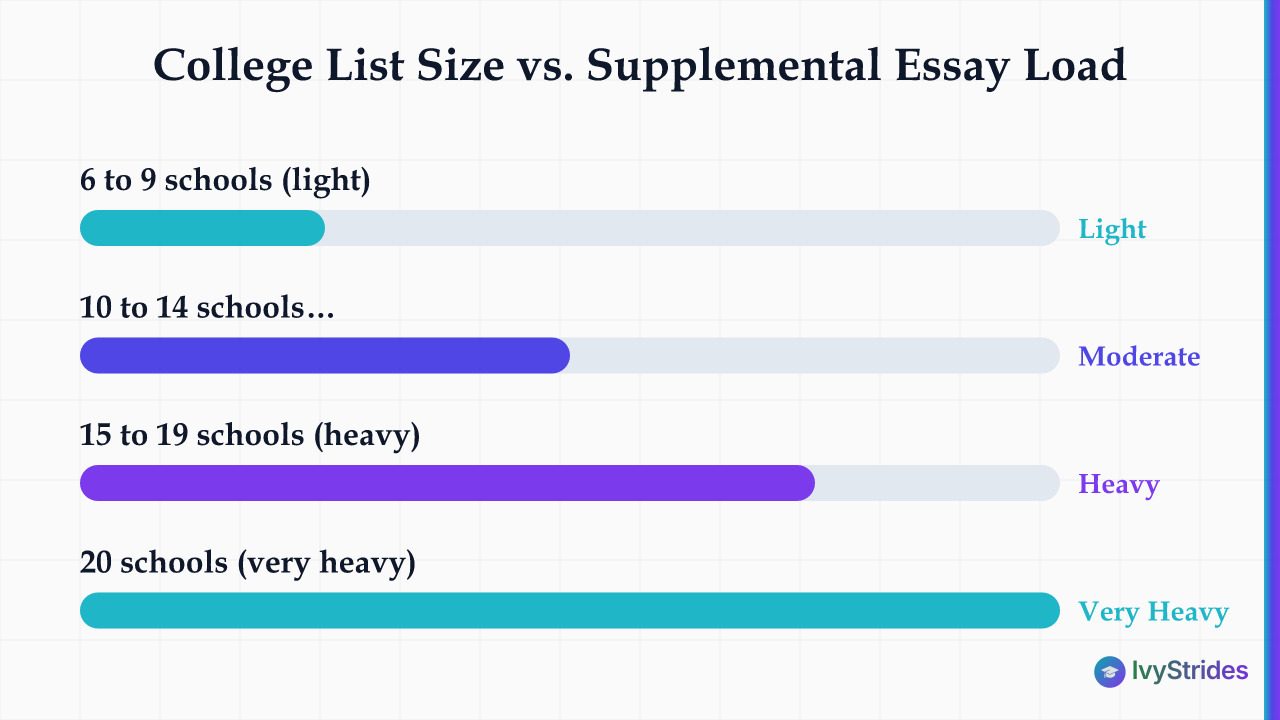
IvyStrides' baseline for most students is 10 to 14 colleges, split into reach, target, and safety tiers. That range gives you real options across the selectivity spectrum without stretching your essays thin: 2 to 3 safety schools, 5 to 7 target schools, and 2 to 3 reach schools.
Why not apply to everything? Each school on your list usually means its own set of supplemental essays. The Common App personal essay is one piece of writing, capped at 650 words, that goes to every school. The supplements, though, multiply with each name you add.
The write-what-you-can-finish rule. Common App lists 1,100+ member colleges and lets you apply to up to 20 of them. That ceiling is not a target.
| List size | Estimated supplemental essays | Risk |
| 6 to 9 | Light | Too few options if reaches miss |
| 10 to 14 | Moderate | Balanced, the recommended band |
| 15 to 19 | Heavy | Essay quality starts slipping |
| 20 (the cap) | Very heavy | Research and voice both thin out |
Look at the table before you add a school. If a new name pushes you into the next row, it has to earn its place, and how many supplemental essays you will write shows the count school by school.
How to Classify Each College on Your List as Reach, Target, or Safety
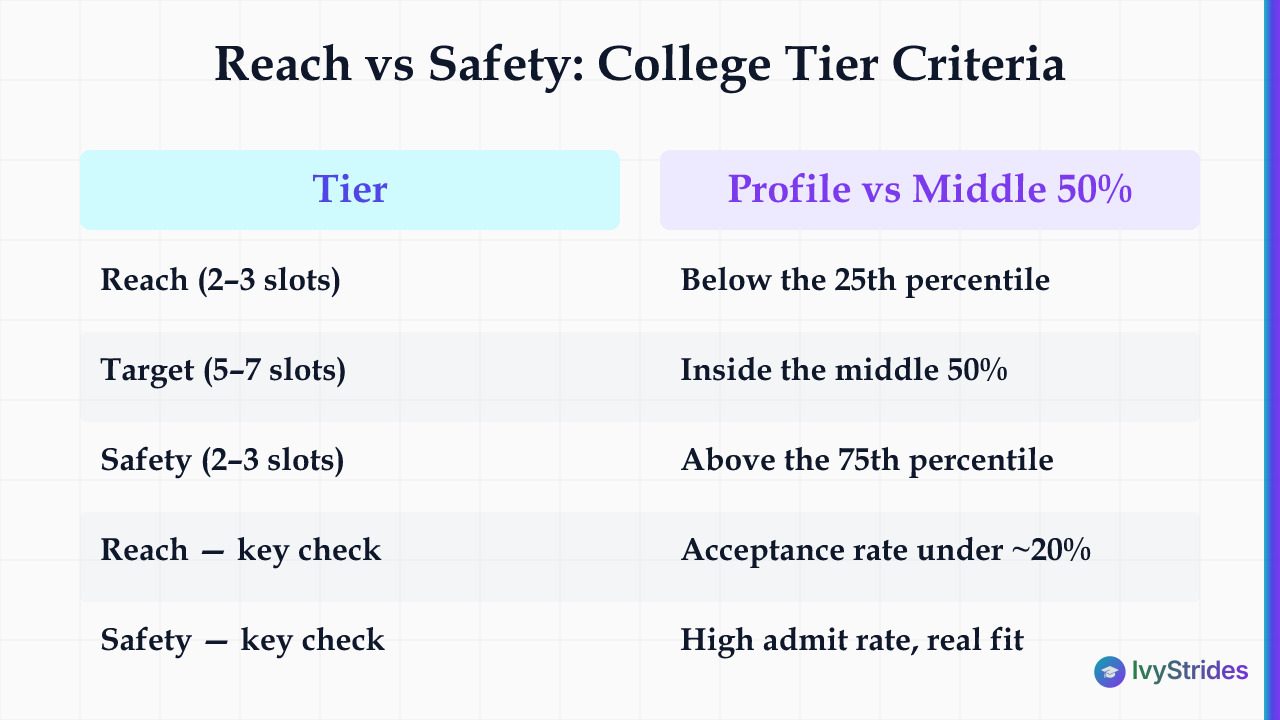
A school's tier is set by how your profile compares to its admitted class, not by its name. The same college can be a reach for one student and a target for another. That classification depends on your GPA and test scores against the school's middle 50% data, not on prestige rankings.
Use two public sources. NCES College Navigator publishes per-institution acceptance rates and SAT/ACT 25th to 75th percentile ranges. Each school's Common Data Set adds detail: Section C1 gives applicant and admit counts, and Section C9 shows the SAT/ACT middle 50% of enrolled students who sent a score.
Read the middle 50% correctly. That range describes enrolled students who submitted a score, not everyone admitted. IvyStrides' rule of thumb: if your score sits inside it, the school is a target. Below the 25th percentile with an acceptance rate under roughly 20%, it's a reach. Above the 75th percentile with high odds, it's a safety you'd genuinely attend.
| Tier | Your profile vs enrolled students who sent a score | Slots | What to check |
| Reach | Below the 25th percentile | 2 to 3 | Acceptance rate under ~20% |
| Target | Inside the middle 50% | 5 to 7 | Your scores within C9 range |
| Safety | Above the 75th percentile | 2 to 3 | High admit rate, real fit |
One caveat: test-optional policies vary by school and year, so a withheld score changes how any tier reads. Admissions also depend on the full application, never scores alone. Classifying each school as reach, target, or safety from public data walks through the method step by step. Building that balanced list is the first deliverable when a counselor reviews your list against each college's data.
Why Applying to Too Many Colleges Usually Backfires
Applying to too many colleges backfires because supplemental essay quality drops as the list grows. Most selective schools add their own supplemental essays, which is why list size and essay quality link directly to the tier work above. Past about 15, the "Why This College" answers start to blur.
In our college counseling work, students who apply to more than 15 schools often find their later supplemental essays less specific than their first five. The Common App personal essay stays at one piece, 650 words. A strong "Why This College" answer, though, needs real research into that school's programs, and that research doesn't scale.
Deadlines compound the problem. Fifteen schools can mean fifteen sets of requirements, due dates, and portal logins. Miss one and a reach disappears. A short list you finish cleanly beats a long one you can't track.
Signs your college list is too long:
- You can't name why two schools on your list differ.
- Some schools are there only for prestige, not fit.
- You'd skip a supplemental essay to save time.
- You can't recall a specific program at a school you added.
- Two safeties sit on the list that you wouldn't actually attend.
- You're past 15 schools with no supplements drafted yet.
Honestly, if three of those ring true, cut before you add. A tighter list with specific supplements beats a long one with generic answers. Writing a specific supplemental essay shows what each one requires. One-on-one essay coaching can build each school's "Why This College" answer with you.
How International Applicants Should Adjust Their College List Size
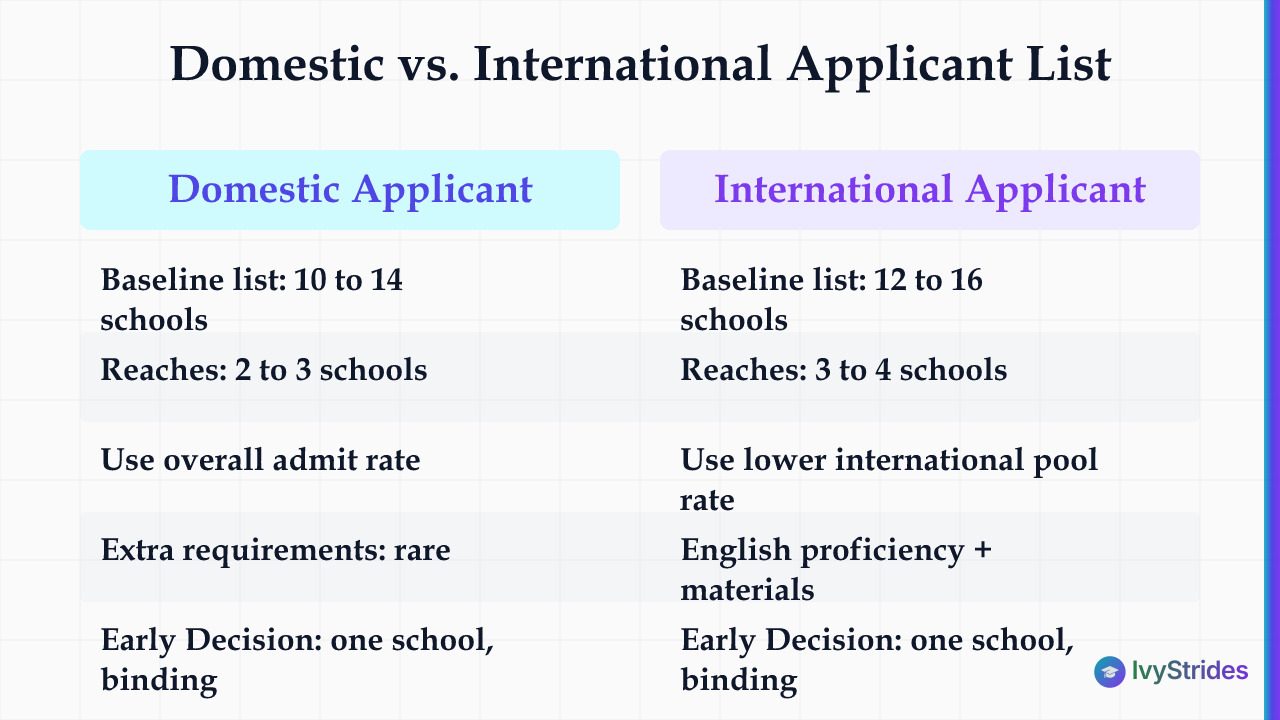
IvyStrides suggests international applicants add 2 to 3 schools to the baseline, landing at 12 to 16 colleges. Selective US colleges can admit international applicants at a much lower rate than their overall rate.
From fall 2025 Common Data Set counts, IvyStrides calculates 2.5% for international applicants at Penn (441 of 17,882) against 4.9% overall, and 7.9% at UT Austin (673 of 8,543) against 22% overall.
That shifts how reaches and targets read for a student applying from abroad.
That gap is the real break from the domestic math above. Check each school's Common Data Set, Section C1, for international applicant data where the school reports it. A college that's a target by your test scores may behave more like a reach for your applicant pool.
Check requirements before you add. Verifying each school's tests, English proficiency requirements, and application materials before adding it tends to produce a shorter, more manageable list. Early Decision is binding and limited to one school, so it anchors the top of your list before you set the rest of the tiers.
| Factor | Domestic applicant | International applicant |
| Baseline list size | 10 to 14 | 12 to 16 |
| Reaches | 2 to 3 | 3 to 4 |
| Admit-rate read | Overall rate | Often lower pool rate |
| Extra requirements | Rare | English proficiency, materials |
| Early Decision | One school, binding | One school, binding |
Because the binding round sets the top of your list first, how Early Decision and Early Action differ matters before you commit. A 12 to 16 school list from abroad is where a counselor who sizes and sequences your list in grades 11 to 12 earns its place.
FAQ: How Many Colleges to Apply To
What is a good number of colleges to apply for?
A good number for most students is 10 to 14 colleges across reach, target, and safety tiers. That range hands you real options without thinning your essay quality. International applicants may add a few schools, since each one's international requirements differ.
How many colleges can you apply to in the US?
Common App, which lists 1,100+ member colleges, lets you add and apply to up to 20 colleges. Colleges outside Common App use their own applications, so your true total can run higher. Your practical ceiling is how many specific supplemental essays you can write well.
Is applying to 15 colleges too many?
Not automatically. At 15 schools the supplemental workload grows, so it turns on whether you can research each school and write a specific "Why This College" essay for every one. If your list holds schools you can't tell apart, cut it.
What is the ideal number of colleges to apply to?
The ideal number is the smallest list that gives you at least two schools you'd genuinely attend in each tier. For most students that lands at 10 to 12. Adding more helps only if each new school is a real fit and you have time for a researched supplement.
Your Next Step on Sizing a College List
Sizing a list is a decision you can make this week, with public data and an honest look at your own profile. The goal isn't the biggest list. It's the shortest one that still gives you real options in every tier.
- Pull each school's acceptance rate and middle 50% range from NCES College Navigator or its Common Data Set.
- Tag every school as reach, target, or safety against your own scores.
- Trim or expand to hit 10 to 14 schools, or 12 to 16 if you're applying from abroad.
- Confirm each school's requirements before you commit a supplemental essay to it.

Hemant is a seasoned entrepreneur, investor, and growth strategist with deep ground in education and technology-driven learning. His core training is in Mathematics and Physics — he authored Physics for IB Diploma: Ultimate Revision Guide, recognized as a top student resource.